
The short answer
A triathlon is a race made of three sports done back to back: a swim, then a bike ride, then a run. One clock runs from the start to the finish line, including the two changes in between, called transitions. Races range from a 750 m swim, 20 km bike and 5 km run (a Sprint) up to a 3.8 km swim, 180 km bike and 42.2 km run (a Full).
The order, and why the clock never stops
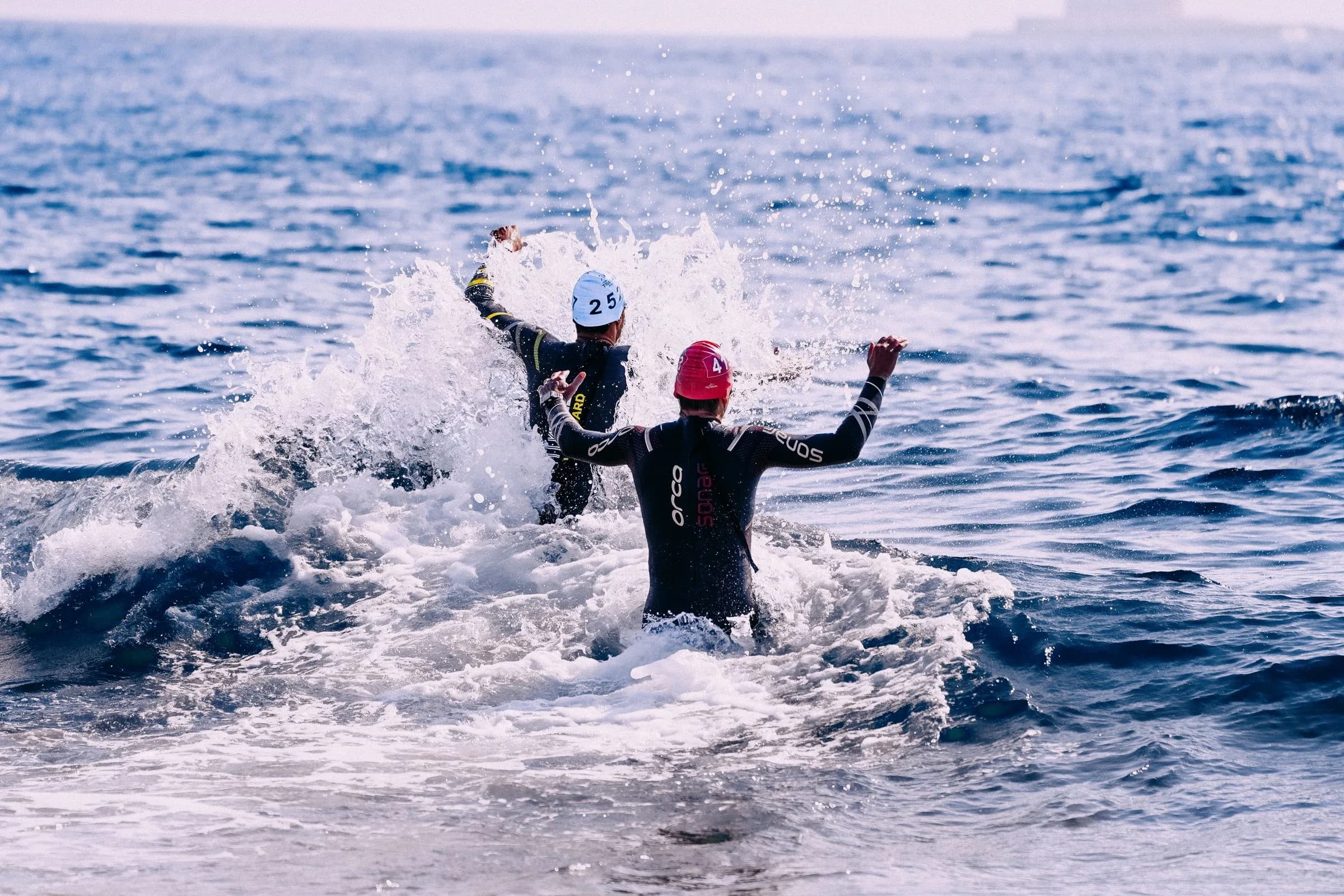
The order is always swim, bike, run. You start in open water or a pool, come out and run to your bike, ride the bike course, leave the bike on its rack and run to the finish. The changes are called T1 (swim to bike) and T2 (bike to run), and they happen in a fenced transition area where your bike and gear wait for you.
Your finish time is the total: swim, T1, bike, T2 and run added together. That is the first thing that separates a triathlon from three separate workouts. A slow change costs exactly as much as a slow kilometre, which is why transitions get their own explainer and their own calculator.
The distances in one table
| Name | Swim | Bike | Run |
|---|---|---|---|
| Sprint | 750 m | 20 km | 5 km |
| Olympic | 1.5 km | 40 km | 10 km |
| Half | 1.9 km | 90 km | 21.1 km |
| Full | 3.8 km | 180 km | 42.2 km |
World Triathlon fixes the Sprint and Olympic distances exactly; its rulebook then sets ranges for middle and long distance races, which the Half and Full sit inside. Organisers of local races adjust the numbers to fit their water and roads, so always check the event page. The full breakdown, with miles, is on the distances page.
Where it came from
The first modern triathlon was held on 25 September 1974 at Mission Bay in San Diego. Forty-six members of a local track club did a 5.3 mile run, a 5 mile ride and a 600 yard swim as an alternative to a track workout. The sport joined the Olympic Games at Sydney in 2000 over the 1.5 km, 40 km, 10 km course, and the long-distance branch grew separately: IRONMAN races use the 3.8 km, 180 km, 42.2 km format that now defines a Full.
What makes it different from doing three sports
Three things catch newcomers. First, the rules: in most age-group races you may not draft behind another cyclist, you must wear a fastened helmet from the moment you take your bike off the rack, and headphones are banned. The rules page covers what gets penalised.
Second, the logistics. You bring everything for three sports to one place and set it up before the start, so most of the work of a good race happens before it begins: a packing list, a plan for the race week and a calm morning. Third, the swim: open water is a different skill from a pool, and the start of the swim is where first-timers feel it most.
Entry age depends on the distance. Under World Triathlon rules the minimum age is 16 for a Sprint and 18 for an Olympic distance, and national bodies and organisers set their own junior categories.
Picking a first race
Most beginners start with a Sprint, which most people finish in about an hour and a half to an hour and three quarters. Find one near you in the race directory, then read what to know before your first triathlon and how long each distance takes.
Sources
- World Triathlon Competition Rules, 13 December 2025 edition, Appendix A (competition distances and minimum ages), as hosted by Triathlon Manitoba
- World Triathlon, San Diego, the birthplace of triathlon
- World Triathlon, about and history (Olympic debut, Sydney 2000)
- Marathon Handbook, average triathlon times by distance
Published 2026-10-20. Your race's athlete guide always has the final word on its rules and times.
Questions
What is a triathlon in simple terms?
A triathlon is a race where you swim, then ride a bike, then run, one straight after the other, with a single clock running from start to finish. The two changes between the sports are timed as part of the race.
What order are the triathlon events in?
Always swim, bike, run. The change from swim to bike is called T1 and the change from bike to run is called T2.
How long is a triathlon?
It depends on the distance. A Sprint (750 m swim, 20 km bike, 5 km run) takes most people about an hour and a half to an hour and three quarters, an Olympic about three hours, a Half about six hours and a Full about twelve and a half.
Is a triathlon harder than a marathon?
Not by default. A Sprint or Olympic triathlon is shorter and less taxing than a marathon, while a Full triathlon ends in a full marathon after a 3.8 km swim and a 180 km ride. Difficulty depends on the distance you pick.
Can a beginner do a triathlon?
Yes. Sprint triathlons are built for first-timers, many are held in pools or calm lakes, and most are open to any adult who can swim the distance. Check the event page for the swim format and any age limits.