
24-hour clock, for example 07:30
/100 m
m:ss, for example 2:00
km/h
/km
m:ss, for example 5:45
m:ss
m:ss
Predicted finish time
2:51:15
Add a start time to see the time of day at each leg.
- Swim
- 30:00
- T1
- 2:30
- Bike
- 1:20:00
- T2
- 1:15
- Run
- 57:30
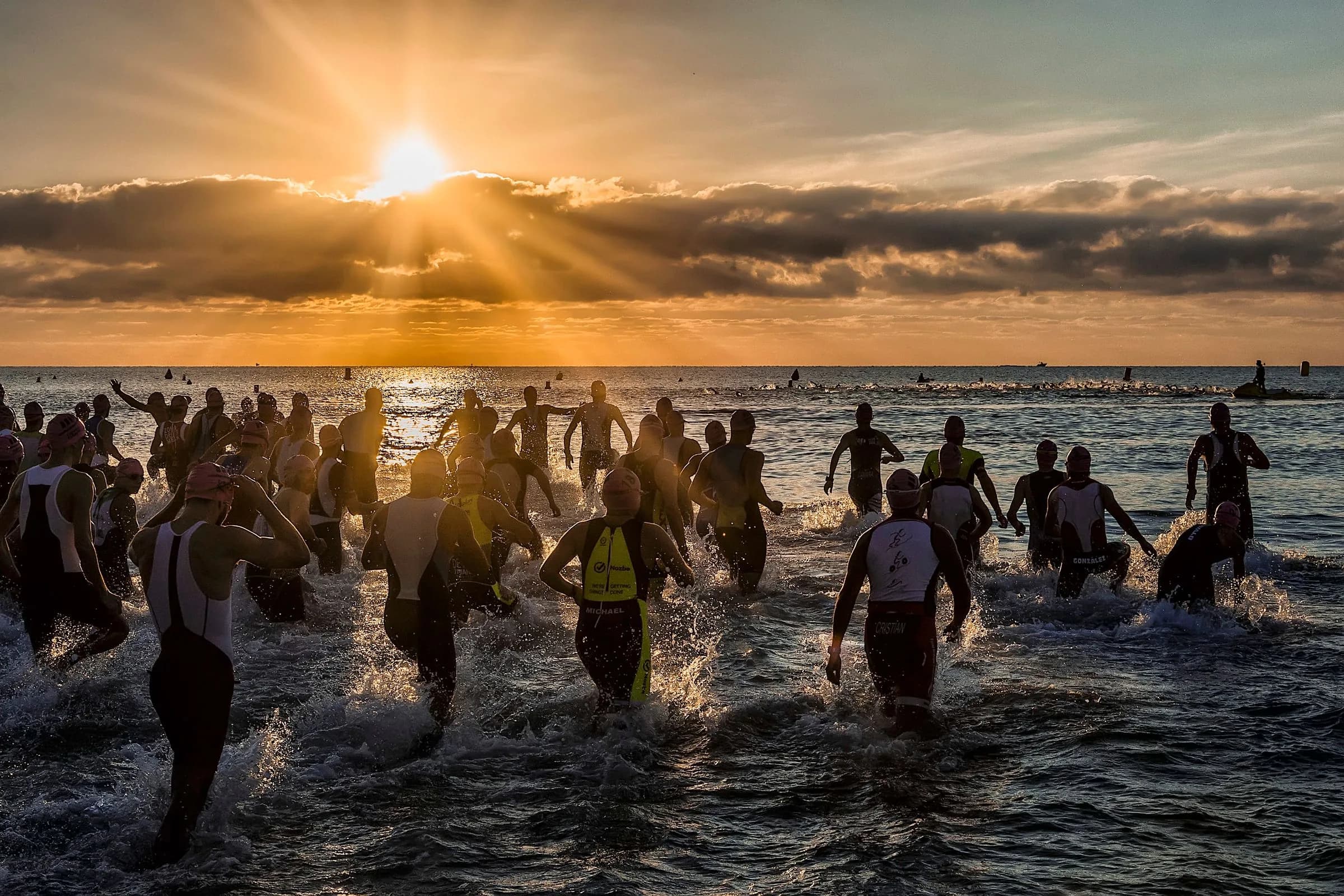
Predict your triathlon finish time from your swim pace, bike speed and run pace, with both transitions. Pick Sprint, Olympic, Half or Full and see every leg.
24-hour clock, for example 07:30
m:ss, for example 2:00
m:ss, for example 5:45
m:ss
m:ss
Predicted finish time
2:51:15
Add a start time to see the time of day at each leg.
Your finish time is the sum of five parts: the swim, T1, the bike, T2 and the run. Each leg is the distance multiplied by the pace you enter. The swim is your pace per 100 m times the swim distance in hundreds of metres, the bike is the distance divided by your speed, and the run is your pace per km times the run distance.
There is no hidden fatigue factor. Your pace is the pace you expect to hold on race day, so enter what you can sustain for the whole leg, not your best 400 m or your fastest 5 km. For a long race that usually means a swim pace a few seconds slower than your pool test, a bike speed from your longest steady ride, and a run pace slower than your stand-alone run.
The distances are the standard ones. Sprint is 750 m, 20 km and 5 km. Olympic is 1.5 km, 40 km and 10 km. Half is 1.9 km, 90 km and 21.1 km. Full is 3.8 km, 180 km and 42.2 km. Choosing a distance fills in sensible default paces and transitions that you can overwrite.
These are published average finish times for age-group finishers, to help you check that your inputs are realistic. They are averages of everyone who finished, so they include many slower and many faster athletes, and they vary a lot with course, weather and experience.
All of these figures are collected on Marathon Handbook, which names the original analyses. We could not open every original, so treat them as ballpark averages. A hilly or hot course can add a lot. If your prediction lands far outside these ranges, check that your paces are for the whole leg and not a short effort.
A finish time is only useful if your plan matches it. Use it to set your hourly fuel with the race fueling calculator, to see if a Full or Half cutoff is a risk with the cutoff calculator, and to budget your changes with the transition time calculator.
The week before is where many races are won or lost. The race week checklist and the packing list cover the rest, and you can find your race to see its course and dates.
It depends on the distance. Published averages for age-group finishers are about 1:36 to 1:46 for a Sprint, 2:53 to 3:07 for an Olympic, around 6:00 for a Half and around 12:35 for a Full (compiled by Marathon Handbook from TriGearLab, Triathlete and RunTri analyses). Course, heat and experience move these a lot.
Add your expected swim, T1, bike, T2 and run times. Each leg is its distance times your pace, and you should use the pace you can hold for the whole leg on race day, not your best short effort.
As a rough estimate, about 1 to 3 minutes each in a Sprint or Olympic race with racked kit, 2 to 5 minutes in a Half, and 3 to 10 minutes in a Full with a change tent. These are our estimates, not published norms. The transition time calculator builds one for your race.
A rough estimate: many age groupers swim somewhere between 1:50 and 2:30 per 100 m in open water, though this is not a published norm. Open water is usually a little slower than the pool because of sighting, waves and other swimmers, and a wetsuit can bring it back.
Yes. After a long bike, most athletes run a Full marathon noticeably slower than a stand-alone marathon, so use a pace you can hold on tired legs, not your fresh running pace.